
A VC fund should host a podcast to get a repeatable, non-awkward reason to spend an hour with senior people who would otherwise require a warm introduction. That access mechanism holds up. Inbound deal flow and LP conversion, the two outcomes most often attributed to fund podcasts, do not.
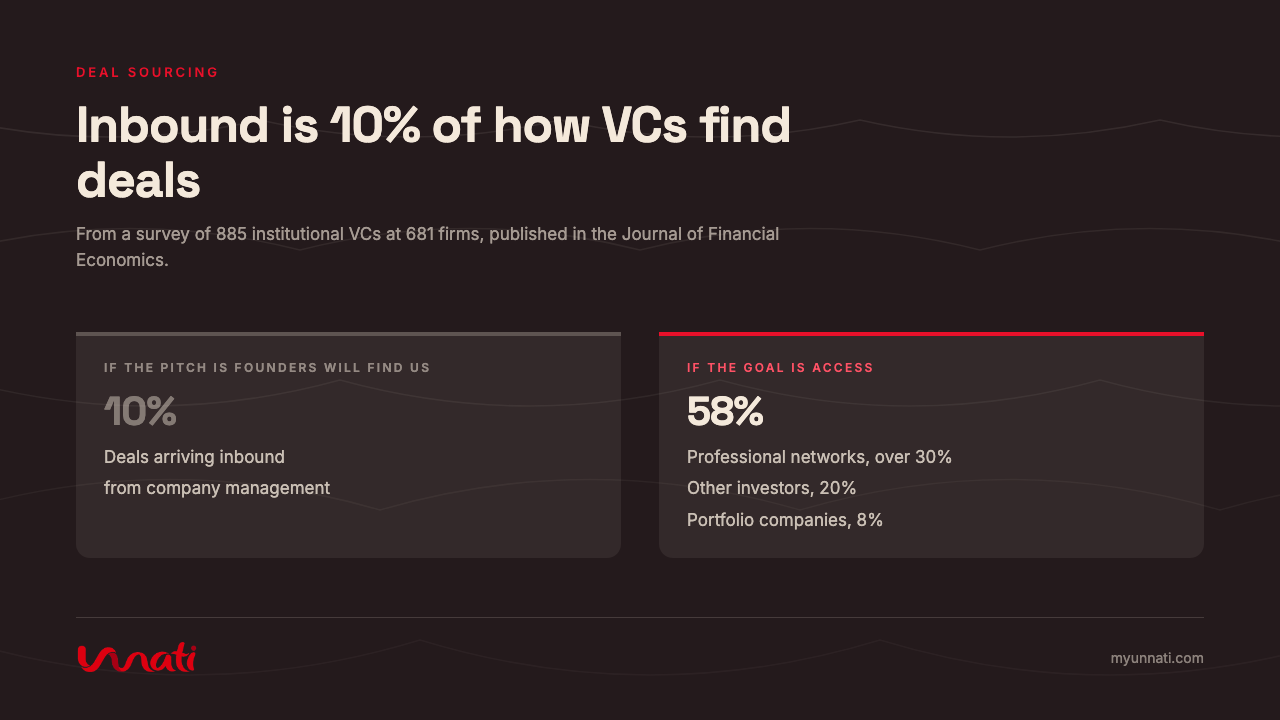
A fund podcast is a partner-hosted interview show that converts an ordinary cold ask into an invitation a senior operator, founder or co-investor will accept. Over 30% of venture deals come through professional networks, almost 30% are proactively self-generated, 20% are referred by other investors, 8% come from portfolio companies, and only 10% arrive inbound from company management. “Founders will find us” targets the 10% slice. “A recorded conversation with 40 senior people a year we want in our network” targets the 58% arriving through networks, investors and portfolio companies.
Does a VC podcast generate deal flow?
A VC podcast does not generate deal flow the way the pitch assumes. The mechanism is access, not sourcing.
Nick Moran, who launched The Full Ratchet in May 2014 and founded New Stack Ventures in 2015, put it as “founders want access to decision-makers, and we provide that warm on-ramp to firms on the coasts.” For Ben Gilbert of Acquired, an April 2024 SEC filing showed he and David Rosenthal were raising a fund, which Gilbert called “just a vehicle with a small set of LPs that lets us fully utilize those allocations when they’re offered to us.” The show generated the offers and the fund was built to absorb them, the inverse of a fund starting a show to find deals.
There is little difference between the pipeline sources of high and low IPO firms. The critical differentiating factor is the quality of the referral network. Adding a channel is not the win. Improving the quality of who is in the network is, and that is far narrower than the claim most fund podcasts are launched on.
Why did a16z buy a podcast network?
a16z bought a podcast network because media is the firm’s product, not a side channel. On 21 April 2025, a16z, a venture firm with the largest in-house media operation in the industry, acquired the podcast network Turpentine and made its founder, Erik Torenberg, a general partner. Marc Andreessen has written that the firm decided early to treat venture “as not only a craft, but also a product,” and that it “sometimes called ourselves ‘a media company that monetizes via investing’.”
A firm with complete access to its own attribution data bought a podcast network and gave its founder GP economics. That is a16z’s situation rather than a template: the firm reported one million podcast downloads a month in June 2026, and tells founders “we can guarantee you distribution.”
Do VC podcasts help raise from LPs?
A VC podcast does not raise LP money directly, and not on the timeline of a live raise.
- Reputation is priced: offers from high-reputation VCs are three times more likely to be accepted, at a 10 to 14% equity discount.
- Differentiation is a prerequisite: in the US, experienced firms captured 90.9% of capital raised in Q1 2026, up from 73.7% for full-year 2025.
What LPs price is a differentiated strategy and a clear manager-strategy fit, not media. “LPs want differentiation” is not “LPs want a podcast.”
Which VC podcast formats work?
Four VC podcast formats work, each needing very different resourcing. Confusing them is the most common planning error.
| Pattern | Example | Shape | What it is for |
|---|---|---|---|
| Podcast preceded the fund | 20VC (Harry Stebbings) | Near-daily | The media property came first; the fund was built on it |
| In-house media operation | a16z | Ten-plus shows, acquired a network | Distribution as a portfolio service |
| Partner-hosted flagship | First Round In Depth (Brett Berson), Lightspeed Generative Now (Michael Mignano), Prime Venture Partners (Amit Somani) | Weekly to fortnightly, a partner hosting | Network access and reputation |
| Prestige limited series | Sequoia Crucible Moments (Roelof Botha) | Seasons, not continuous | Portfolio legacy, not sourcing |
Most fund shows sit in the US market, but the pattern travels: 20VC is UK-based, and Prime Venture Partners in India has run a partner-hosted show since 2019.
Did the 20VC podcast create Harry Stebbings’ fund?
The 20VC podcast did not create the fund, and the timeline is the easiest thing to misread. Stebbings published his first episode of 20VC, an interview show now running near-daily, on 10 January 2015, aged 18.
He co-founded Stride.VC in 2018, a fund that closed at half its target. His own fund raised $8.3M in July 2020 and $400M in October 2024, reaching $650M under management by June 2025. That is five and a half years of publishing before a fund under his own name. Anyone compressing it into “podcast, therefore $400M fund” is repeating a myth.
Stebbings has described spending 20% of his time on the podcast and 80% on the fund, supported by a 13-person media team.
What is the Sequoia Crucible Moments model?
Crucible Moments is Sequoia Capital’s prestige limited series, hosted by partner Roelof Botha, which runs biweekly within seasons rather than continuously. It is the pattern most funds should study, because it is the only one at the top of the industry that does not demand infinite weekly output.
Every company on its published list is Sequoia-backed, which makes it portfolio storytelling rather than sourcing. From the outside a paused season and a dead show look identical.
Why do VC podcasts get cancelled?
VC podcasts get cancelled for reasons other than resources. a16z, Bessemer and Greylock all had them. Shows tied to one person die when that person moves on; shows structured as firm assets survive.
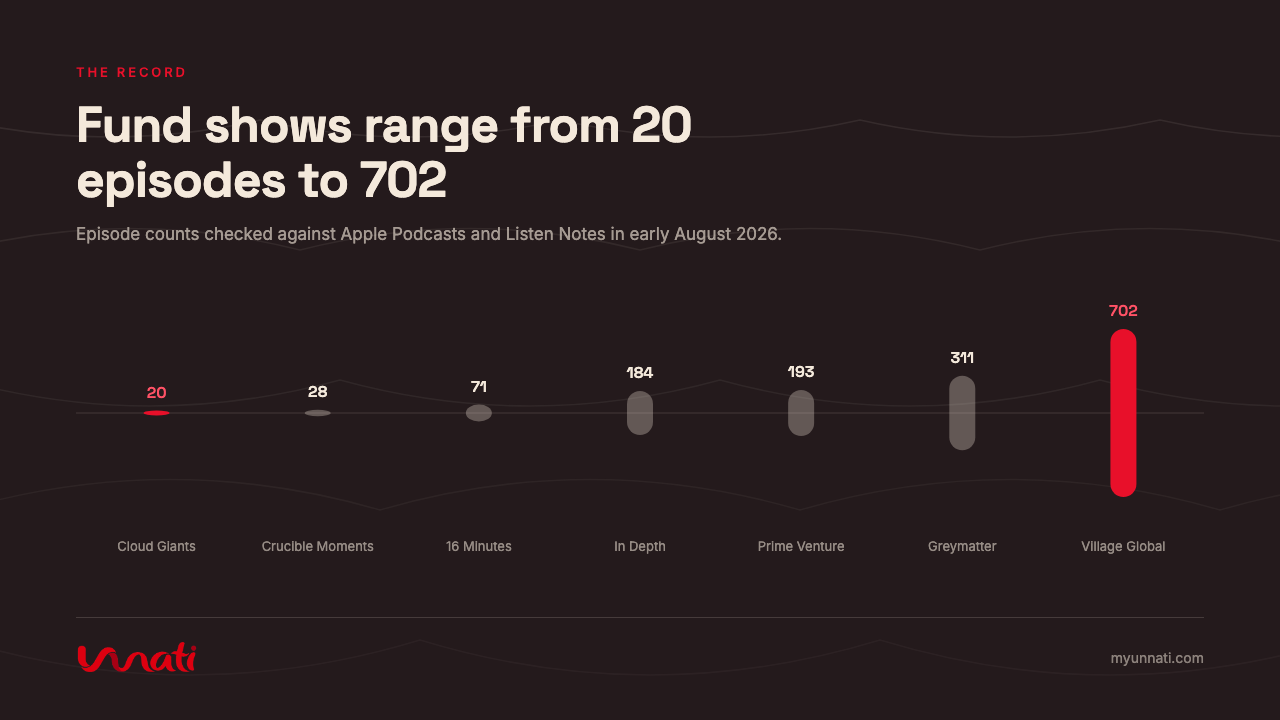
- 16 Minutes, a16z. Stopped on 22 February 2022, when showrunner and host Sonal Chokshi said on air the feed was going on hiatus “temporarily,” pending a new host. Four years later there has been no relaunch.
- Cloud Giants, Bessemer. 20 episodes between March 2020 and 7 July 2023, silent since, despite guests including Eric Yuan of Zoom and Frank Slootman of Snowflake. Twenty episodes across more than three years is one every two months, so it was fading well before it stopped.
- Greymatter, Greylock. Ran from 29 February 2016; its last episode, on 24 June 2025, was a cross-promotion for a different show.
Two shows survived the same conditions. First Round’s In Depth, hosted by partner Brett Berson, has published since October 2020 at one every 11 days. Village Global’s show has published since December 2017, surviving both a rename from Venture Stories and the April 2025 departure of founding host Erik Torenberg, with rotating hosts taking over.
Funds announce launches and never announce endings.
How long do most podcasts last?
Most podcasts last 2.4 years, the median publishing span. A fund committing to a podcast is committing past the point where the median distributed show has already stopped.
A fixed season with an announced end is a commitment a fund can keep. An open-ended weekly show is not.
What audience does a VC podcast get?
A VC podcast gets a smaller audience than the pitch decks suggest. The median episode gets 27 downloads in its first seven days. The top 10% get 407.
Composition is the number that matters more than volume. Acquired’s audience is 76% people working in tech, finance and investing, 35% C-level or VP-level, 14% active CEOs. A thousand listeners who are all operators and allocators is a different asset from a hundred thousand general listeners.
Why are podcast downloads a bad KPI?
Podcast downloads are a bad KPI because the number moves when platforms change defaults, with no change in the underlying audience. Apple’s iOS 17, shipped 18 September 2023, pauses automatic downloads for followers who have not listened to one of the last five episodes within 15 days.
Daily shows lost 10% of monthly downloads a month afterwards and longer non-daily shows about 30%. A metric that can fall 30% for that reason cannot be an LP-update number. Downloads are not people.
When not to start a VC podcast
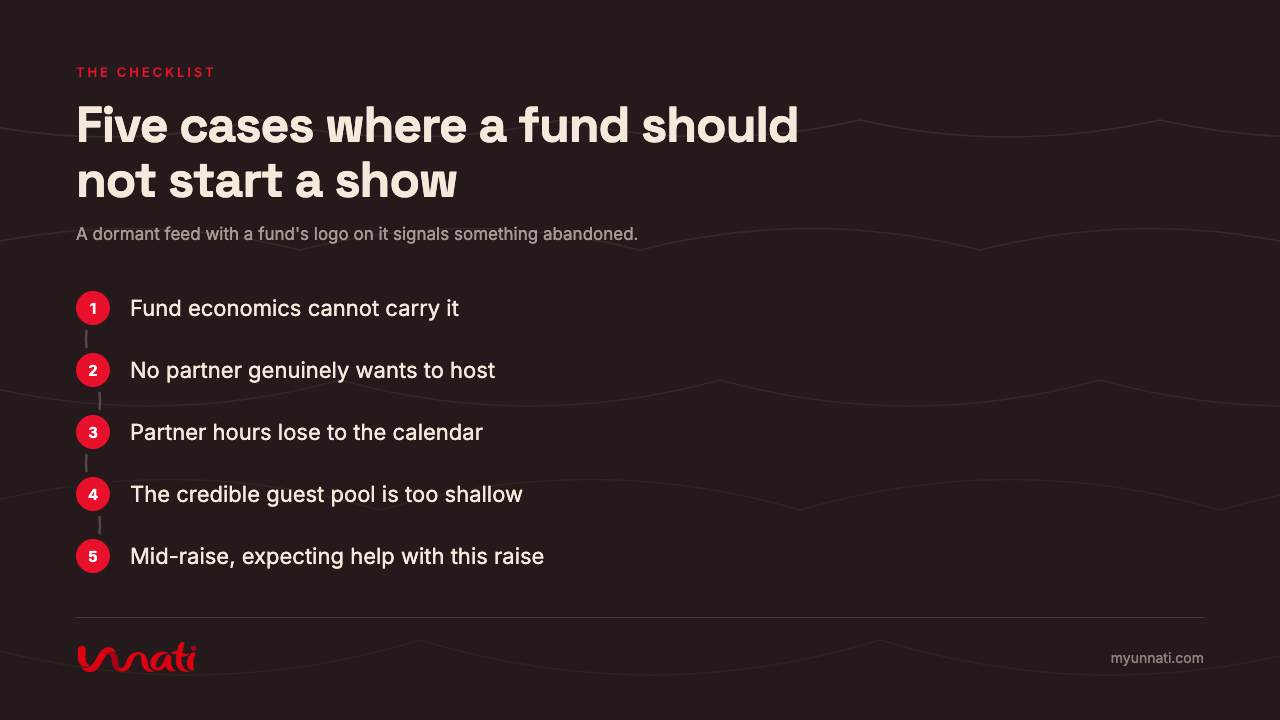
A VC fund should not start a podcast in five cases. The failure mode is public: a dormant feed with a fund’s logo on it signals something abandoned.
When the fund economics cannot carry it. The median US VC fund size was $15.3M in Q1 2026, down from $25.0M in 2025, and emerging managers average $12M. A standard management fee on a fund that size has to cover salaries, rent, legal, audit, travel and software combined. There is no room in that for a sustained media operation and no person to run it, which puts the show one busy quarter from dormancy.
When no partner wants to host. Delegating to a junior hire removes the only asset the show has, which is a senior person’s access and judgement.
When the partner-hours don’t survive contact with the calendar. A weekly show costs a partner 10 to 13% of the working year, locked to other people’s availability.
When the credible guest pool is too shallow. A weekly show burns 48 to 50 guests a year, so on a narrow thesis the A-tier list is exhausted inside 12 months and visible quality decay follows. It is why the seasonal model exists.
When the fund is mid-raise and expects the show to help this raise. It will not; the timelines run in years. Stebbings published from January 2015 and did not raise under his own name until 2020.
How many hours does a VC podcast take?
Partner-only time per interview episode runs 4 to 5 hours: making the ask personally, reading the material, recording, approving the cut, and promotion, with production on top.
| Cadence | Partner hours per year | Share of a 1,900-hour partner year |
|---|---|---|
| Weekly | 192 to 240 | 10 to 13% |
| Fortnightly | 96 to 120 | 5 to 6% |
| Monthly | 48 to 60 | 3% |
VC podcast regulations in the US
VC podcast regulation raises one jurisdiction-specific issue that belongs with counsel before anything is recorded. In the United States, a fund raising under Rule 506(b) cannot engage in general solicitation, and a public podcast touching the fund’s own offering is exactly that; Rule 506(c) permits it but requires verifying every purchaser is accredited.
Separately, the SEC Marketing Rule, compliance date 4 November 2022, applies to SEC-registered advisers. It excludes “extemporaneous, live, oral communications” from the definition of advertisement “regardless of whether they are broadcast” but does not exclude prepared or scripted remarks, which is why a produced, edited episode sits differently from a live one. Exempt reporting advisers, a category many venture firms fall into, remain subject to antifraud provisions regardless.
VC podcast alternatives
VC podcast alternatives number five, and three of them attribute better. All five compete for the same partner hours. A podcast wins only when a partner personally wants recurring access to senior people.
| Channel | Time shape | Measurable? | Best when |
|---|---|---|---|
| Weekly interview podcast | 192-240 partner hrs/yr, calendar-locked to others | No named-listener attribution | A partner wants recurring access to ~48 senior people and will host personally |
| Seasonal series | Fixed episode count with an end date | Same limitation | The guest pool is finite, or capacity is seasonal |
| Newsletter or essays | Writer’s own schedule, no guest dependency | Yes, per named subscriber | The differentiated view is a thesis, or attribution matters |
| Annual research artifact | Once-a-year concentrated effort | Partial | Reputation is the goal and recurring cadence is unrealistic |
| Dinners and small events | Per-event, front-loaded | Attendee list is the metric | The goal is 30 target founders in a room this quarter |
The measurability gap is structural: email attribution attaches to a named individual, while podcast RSS delivery has no login, no cookie and no cross-device identity. Bessemer, a venture firm whose State of the Cloud research is an annual industry benchmark, earns a comparable reputation effect from that research on a once-a-year effort, and its podcast is the one that went dormant.
Frequently asked questions
Should a partner host the VC podcast?
What cadence should a VC podcast commit to?
How do you measure a VC podcast?
Is video mandatory for a VC podcast?
Do podcasts help with AI answer engines?
How many downloads does a podcast episode get?
Can a VC podcast bring inbound deal flow?
Should a fund mid-raise start a podcast?
Sources (49)
- How Do Venture Capitalists Make Decisions?, NBER Working Paper 22587 (PDF) deal sourcing splits, 22 hours/week networking out of a 55-hour week, 200 companies screened per 4 investments, and both halves of the pipeline-sources caveat including the quality of their referral network sentence.
- How Do Venture Capitalists Make Decisions?, Harvard Law School Forum on Corporate Governance free summary of the same figures.
- How do venture capitalists make decisions?, Journal of Financial Economics 135(1), 2020 the peer-reviewed publication of record.
- What Do Entrepreneurs Pay for Venture Capital Affiliation?, Journal of Finance 59(4), David Hsu and the Knowledge at Wharton summary 3x acceptance likelihood, 10-14% equity discount, 51 startups and 148 offers surveyed in 2000.
- Q1 2026 PitchBook-NVCA Venture Monitor (PDF), NVCA 90.9% of capital to experienced firms vs 73.7% in 2025, clear, differentiated edge, a differentiated strategy and a clear manager-strategy fit are now prerequisites, median fund size $15.3M in Q1 2026. US dataset.
- Introducing Erik Torenberg, a16z 21 April 2025; the Turpentine acquisition, Torenbergs GP appointment, and a media company that monetizes via investing.
- a16z acqui-hires VC tech podcaster Erik Torenberg, TechCrunch independent confirmation, dated 21 April 2025.
- New Media, One Year In, a16z 18 June 2026; a16zs audience figures and the distribution guarantee offered to portfolio companies.
- 20VC closes new $400M fund, TechCrunch $400M with the $125M/$275M split and the founder and GP LP roster.
- Podcaster Harry Stebbings pulls in $400M for latest 20VC fund, PitchBook MIT Investment Management Company, RIT Capital Partners and Mubadala as LPs.
- $40 Mic To $650 Million Firm, Forbes 30 June 2025; $650M AUM.
- Harry Stebbings raises two funds totalling $140m, Sifted and Harry Stebbings raises $400m for third fund, Sifted the 20%/80% time allocation and the 13-person media team.
- Stride.VC sees first £40M closing, TechCrunch and Stride.VC raises £50M seed fund, TechCrunch the pre-20VC fund, closed at half its £100M target.
- Harry Stebbings, Wikipedia and 20VC, Wikipedia first episode 10 January 2015 and the dated fund timeline.
- New Stack Ventures raises second fund, TechCrunch Nick Morans on-record quotes including the warm on-ramp to firms on the coasts.
- About Nick Moran & Origin of TFR, The Full Ratchet May 2014 launch, four years before New Stacks first institutional fund.
- Ben Gilbert and David Rosenthal are raising an investment fund, GeekWire the April 2024 SEC filing and the fully utilize those allocations quote.
- About Acquired audience composition: 76% in tech, finance and investing, 35% C-level or VP, 14% active CEOs.
- Crucible Moments, Sequoia Capital and the Listen Notes entry Roelof Botha as host, 28 episodes across 3 seasons, first episode 30 August 2023, most recent 4 December 2025.
- In Depth, First Round Review and the Listen Notes entry Brett Berson as host, 184 episodes from 15 October 2020 to 30 July 2026, roughly every 11 days.
- Village Global Podcast, Listen Notes 702 episodes from 11 December 2017 to 29 July 2026, still publishing after a rename and the founding hosts departure.
- Prime Venture Partners Podcast, Apple Podcasts 193 episodes, hosted by managing partner Amit Somani, still publishing in August 2026. A long-running non-US partner-hosted show.
- 16 Minutes News by a16z, Apple Podcasts and the final episode page, a16z 71 episodes, last one 22 February 2022, Sonal Chokshis hiatus-pending-a-new-host sign-off.
- Cloud Giants, Listen Notes and Bessemers own page 20 episodes, 3 March 2020 to 7 July 2023, dormant since.
- Greymatter, Listen Notes 311 episodes from 29 February 2016, last one 24 June 2025.
- Introducing Generative Now, Lightspeed the shows origin in the firms in-person meetups, hosted by partner Michael Mignano.
- A surprisingly small number of podcasts are still in production, Amplifi Media the July 2022 Podcast Index analysis with Podnews: about 4 million feeds, 47% with three or fewer episodes, just under 4% meaningfully active.
- The Podfade Problem, WhichPodcast 36,857 directory-listed shows computed 5 August 2026: 96%/60%/20% reaching 10/100/500 episodes, 73.5% active in the last 30 days, median 2.4-year publishing span.
- Buzzsprout Global Podcast Stats August 2026, IAB 2.2-compliant 7-day download percentiles across 112,701 active podcasts: median 27, top 10% 407, top 1% 4,526.
- The iOS 17 changes in Apple Podcasts, Podnews the NPR, Triton, Podtrac and Acast figures on post-iOS-17 download declines.
- Notice: Updates to Automatic Downloads, Apple Podcasts for Creators Apples own description of the rule change.
- Are my podcast downloads declining because of iOS 17?, Bumper downloads arent people.
- The Podcast Consumer 2026, Edison Research and the Podnews release 82% watching versus 78% audio-only, against 89% audio-only versus 73% video in 2023. US data.
- Emerging Manager Venture Capital: The Complete Guide, VC Lab approximately $12M average fund size out of the VC Lab programme.
- Industry Standard Terms for Emerging Fund Managers, Sydecar standard management fee terms, and the acknowledgement that a standard fee on a modest fund may not fund a platform.
- How Much Time Does it Take to Run a Podcast?, The Podcast Host the production-time bands underpinning the partner-hours estimate.
- Investment Adviser Marketing, Federal Register the Marketing Rule adopting release and the extemporaneous-live-oral exclusion, which does not extend to prepared or scripted remarks.
- Rule 506(c) Private Offerings, Ward and Smith 506(b) versus 506(c) on general solicitation.
- The Marketing Rule and Exempt Reporting Advisers, Croke Fairchild ERAs are not required to comply but remain under antifraud provisions.
- What Gets Cited: Competitive GEO in AI Answer Engines, arXiv 2605.25517 252,000 trials across six LLMs and 18 content factors, with no mention of podcasts or transcripts.