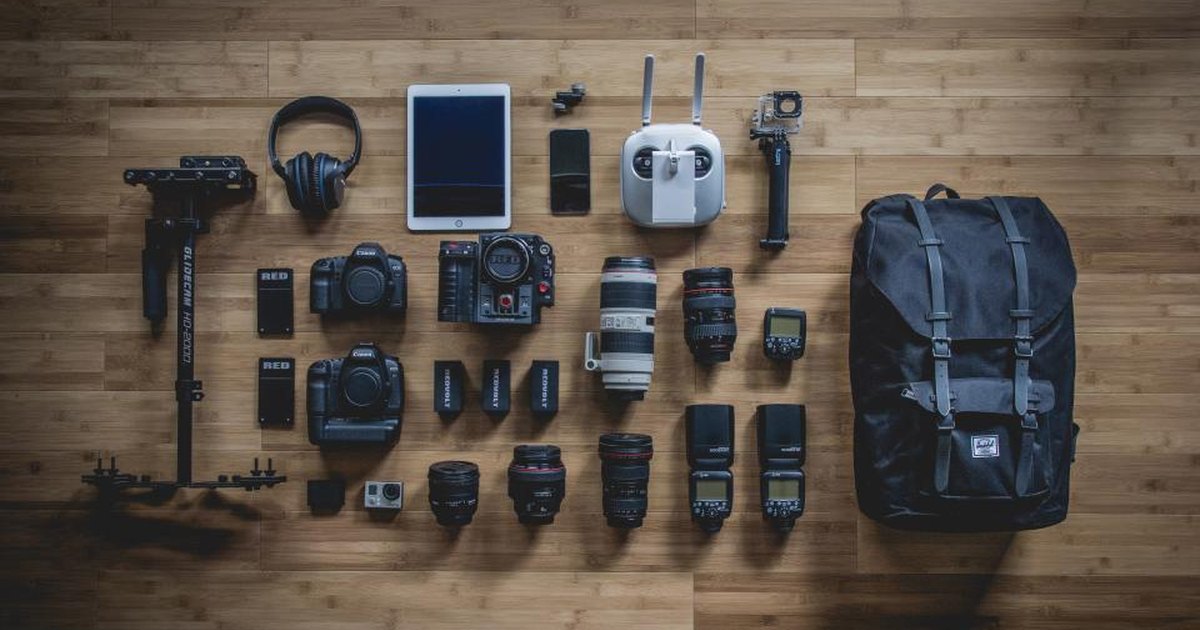

A podcast equipment and camera setup for two people in one room costs about $750 at entry level, about $1,930 in the middle and about $3,780 at the upper end. Buy in this order: room treatment, microphones, lighting, then the camera body. The camera is the last purchase that changes how good the output looks.
A podcast equipment and camera setup is the recording chain that turns a conversation into a publishable episode: room treatment that controls reflections, one dynamic microphone per person, a light that shapes the face, and a camera that records the result. An untreated room is the one problem no purchase further down that list can fix.

How much does podcast equipment cost?
Podcast equipment for two people in one room costs $750.33 at entry level, $1,933.37 in the middle and $3,782.14 at the upper end. A second camera body takes the upper kit to about $4,980. These are US street prices, and the camera lines sit above launch MSRP.
| Kit | Total | What it buys |
|---|---|---|
| Entry | $750.33 | Publishable audio, adequate video |
| Mid | $1,933.37 | Output that no longer looks like a video call |
| Upper | $3,782.14 | A room you would put a customer’s CEO in |
| Upper plus second camera | about $4,980 | A cuttable two-angle conversation |
Entry: $750.33
| Item | Qty | Cost |
|---|---|---|
| Samson Q2U pack | 2 | $159.98 |
| Logitech MX Brio 4K webcam | 1 | $169.99 |
| Elgato Key Light Neo | 2 | $119.98 |
| ROCKWOOL Safe’n’Sound, 59.7 sq ft | 1 bag | $82.38 |
| Audio-Technica ATH-M40x | 2 | $218.00 |
| Total | $750.33 |
If closed-back headphones already exist in the office, the rest of this kit is $532.33. It records publishable audio. Its weak point is the webcam, which is the correct thing to compromise on first.
Mid: $1,933.37
| Item | Qty | Cost |
|---|---|---|
| Rode PodMic | 2 | $172.00 |
| Zoom PodTrak P4next | 1 | $149.99 |
| Rode PSA1+ boom arm | 2 | $224.00 |
| Canon EOS R50 V with RF-S 14-30mm lens | 1 | $849.00 |
| amaran Halo 60x | 2 | $238.00 |
| Audio-Technica ATH-M40x | 2 | $218.00 |
| ROCKWOOL Safe’n’Sound | 1 bag | $82.38 |
| Total | $1,933.37 |
Two XLR cables are not in this total and cost a few dollars each. This is the level at which the output stops looking like a video call. The camera is the largest line and the one most exposed to US price inflation.
Upper: $3,782.14, or about $4,980 with a second camera
| Item | Qty | Cost |
|---|---|---|
| Shure SM7B | 2 | $878.00 |
| Rodecaster Pro II | 1 | $579.00 |
| Rode PSA1+ boom arm | 2 | $224.00 |
| Sony ZV-E10 II with 16-50mm kit | 1 | $1,298.00 |
| amaran Halo 100x | 2 | $338.00 |
| Audio-Technica ATH-M40x | 2 | $218.00 |
| ROCKWOOL Safe’n’Sound | 3 bags | $247.14 |
| Total | $3,782.14 |
A second ZV-E10 II body at $1,198 for reverse-angle coverage takes this to about $4,980. That second camera is worth more to the finished episode than any further microphone upgrade at this level, because it is what makes an hour-long conversation cuttable.
What is the best podcast camera?
The best podcast camera at the mid tier is the Canon EOS R50 V at $619 body-only, and at the upper tier the Sony ZV-E10 II at $1,198 body-only. Both are APS-C mirrorless bodies. A Logitech MX Brio 4K webcam at $169.99 works for audio-first shows and remote guests.
| Level | Model | US price | Sensor | Notes |
|---|---|---|---|---|
| Webcam | Logitech MX Brio 4K | $199.99 list, $169.99 now | 1/2.8” Sony Starvis | 4K30, fixed lens, no shallow depth of field. Its built-in mics are not a substitute for a microphone. |
| Business webcam | Logitech MX Brio 705 for Business | $199.99 | Sony Starvis | Same class, procurement-friendly variant. |
| Mid | Canon EOS R50 V | $719 list, $619 now, body only | APS-C | 4K30 oversampled from 6K, 4K60 with a crop. With the 14-30mm lens, $949 list and $849 now. |
| Upper | Sony ZV-E10 II, body | $1,198 | APS-C | 4K60. Microphone input and headphone jack. |
| Upper | Sony ZV-E10 II with 16-50mm kit | $1,298 | APS-C | The kit lens is the cheapest way to have a working camera on day one. |
Budget for a lens. Mirrorless bodies are quoted body-only, and a body without a lens records nothing. A kit-lens bundle is the cheapest starting point.
Sensor size versus cost. The jump from a webcam’s small sensor to APS-C is the largest single visual difference, and it costs about $450 body-only, or about $680 once the lens is in the basket. It buys two things: a usable image in imperfect light, and the shallow depth of field that separates a person from the wall behind them. That separation is most of what people mean when they say a video “looks professional.”
Lighting outranks the camera body. A small sensor under soft, controlled, correctly placed light produces a more watchable image than a large sensor under office ceiling fluorescents. A camera body records the light in the room. It does not create any.
Is a webcam good enough for a podcast?
A webcam is good enough in two cases: when the show is audio-first and video exists only as clips and a YouTube presence, and for remote guests, where you have no control over their setup anyway. A good webcam at their end plus a good local recording of their audio beats an unusable video call.
What a webcam cannot do is be the main in-studio camera for a show whose whole pitch is production quality, because the small sensor forces everything into focus and flattens the frame.
What is the best podcast microphone?

The best podcast microphone at entry level is a Samson Q2U pack at $79.99, in the middle a Rode PodMic at $86 street or a Shure MV7+ at $299, and at the upper end a Shure SM7B at $439. All are dynamic microphones, which reject room sound better than condensers.
| Tier | Model | US price | Connection | Notes |
|---|---|---|---|---|
| Entry | Samson Q2U Recording & Podcasting Pack | $79.99 | USB and XLR | Ships with desk stand, XLR and USB cables. Dynamic, forgiving in an untreated room. |
| Mid | Rode PodMic | $86 street, $99 at Rode | XLR | Needs an interface or mixer. Built for close-mic speech. |
| Mid | Rode PodMic USB | $190 street, $209 at Rode | XLR and USB-C | Runs straight into a computer or into a mixer. |
| Mid | Shure MV7+ | $299 | USB-C and XLR | Dual output means you can start on USB and move to a mixer later. |
| Upper | Shure SM7B | $439 | XLR | Needs a lot of clean gain. Check your interface or mixer can supply it before buying. |
| Condenser | Rode NT1 5th Gen | $214 | XLR and USB-C | Detailed, and it will also pick up the air conditioning, the corridor and the room. |
Above $300 a microphone, the room becomes the dominant variable. An SM7B in an untreated glass meeting room sounds worse than a $79.99 Q2U in a carpeted office with a bookshelf behind the presenters. If the budget is fixed, the $718 gap between two Q2Us and two SM7Bs buys a lot of stone wool and a boom arm each.
For a company podcast recorded in an ordinary office, a dynamic microphone is the right default, even though the condenser sounds better in isolation.
A Rode PSA1+ boom arm at $112 keeps the microphone at a consistent distance from a moving guest, which does more for consistency than any plug-in. And a pair of closed-back headphones, such as the Audio-Technica ATH-M40x at $109, is how you catch a problem during the recording rather than in the edit.
USB or XLR microphones for a podcast?
Choose USB microphones for one or two people in one room with no live mixing, because USB removes a box and a set of cables from the chain. Choose XLR once you have three or more microphones, want a recording independent of the computer, or need separate headphone feeds.
Dual-output models like the Shure MV7+ at $299 and the Rode PodMic USB at $190 let you start on USB and move to XLR later without rebuying.
Do I need an audio interface or mixer?
You do not need an audio interface or a mixer if you are running one or two USB microphones into a computer. USB microphones like the Q2U, the PodMic USB or the MV7+ plug straight in and record into whatever software you already use. That is a complete signal chain.
You need an interface or a recorder when any of these becomes true:
- You are using XLR microphones, which have no way to reach a computer without one.
- You need three or four microphones at once. Computers handle one USB microphone cleanly and get unreliable beyond that.
- You want a recording that survives a laptop crash mid-interview, which is the argument for a standalone recorder with its own SD card.
- You need everyone in the room on their own headphone feed.
| Model | US price | What it is for |
|---|---|---|
| Focusrite Scarlett 2i2 4th Gen | $224.99 | Two XLR inputs into a computer. The default two-person answer. |
| Zoom PodTrak P4next | $179.99 list, $149.99 now | Four XLR in, four headphone outs, +70 dB gain, records to SD card independently of the computer. |
| Rodecaster Duo | $416 street | Two preamps, four faders, on-board recording. |
| Rodecaster Pro II | $579 street, $699 at Rode | Full production console, four inputs, on-board recording and processing. |
| Rodecaster Video | $949 street, $1,199 at Rode | Video switcher plus a full audio console, for multi-camera video podcasts cut live. |
The Rode consoles sit far below Rode’s own list price at retail. On this category, checking two retailers before buying is worth a few hundred dollars.
What podcast lighting do I need?
Podcast lighting starts at one soft light per person, from $59.99 for an Elgato Key Light Neo. Lighting is the cheapest intervention with the biggest jump in image quality, and it outranks the camera body.
| Model | US price | Notes |
|---|---|---|
| Elgato Key Light Neo | $69.99 list, $59.99 now | The cheapest credible single-light answer. |
| amaran Halo 60x bi-color | $119 | 3,270 lux at 3.3 ft, bare. |
| Elgato Key Light Air MK.2 | $139.99 at Elgato, $119.99 light only | Also listed at $169.99, so check two retailers. |
| amaran Halo 100x bi-color | $169 | 4,890 lux at 3.3 ft, bare. |
| Elgato Key Light | $179.99 | Panel-style, arm-mountable. |
| amaran Pano 60c RGB, 2-light kit with stands | $329 | Stands included, which is a real cost otherwise. |
One trap when comparing brightness. Lux figures are only comparable at the same distance with the same modifier fitted. The discontinued amaran COB 60x S is specified at 33,300 lux at 3.3 ft with its reflector, while the Halo 60x that replaced it is specified at 3,270 lux at the same distance bare. Those two numbers describe similar fixtures. Read the qualifier before concluding one light is ten times another.
Two placement rules do more than the choice of fixture. Get the source physically large and close, because a bare LED an inch across is a hard light that produces hard-edged shadows on a face, while the same LED through a diffuser or bounced off a white wall becomes soft. And switch off the overhead office fluorescents entirely rather than mixing them with your key light, because mixed colour temperature is one of the most reliable ways to make good footage look cheap.
How do I fix a bad-sounding room?
Two inches of dense mineral wool or fiberglass fixes a bad-sounding room. Acoustic foam is the reflexive first purchase and does very little to the frequencies that make a room sound boxy.
| Octave band | Auralex 2” Studiofoam Wedges | Owens Corning 703, 2” | Owens Corning 703, 1” |
|---|---|---|---|
| 125 Hz | 0.21 | 0.17 | 0.11 |
| 250 Hz | 0.24 | 0.86 | 0.28 |
| 500 Hz | 0.63 | 1.14 | 0.68 |
| 1 kHz | 0.97 | 1.07 | 0.90 |
| 2 kHz | 1.10 | 1.02 | 0.93 |
| 4 kHz | 1.09 | 0.98 | 0.96 |
| NRC | 0.75 | 1.00 | 0.70 |
At 250 Hz, the fiberglass absorbs about 3.6 times what the foam does, the frequency where a small hard-walled room rings. Above 1 kHz the two are near-identical, which is exactly why foam feels like it is working. It deadens the sizzle you can hear yourself making while leaving the boxiness that listeners hear untouched.
The 1-inch fiberglass column collapses to 0.28 at 250 Hz, barely better than foam. Thickness is the variable, not surface shape: the wedge panel is 2 inches at its peaks but averages 1.25 inches of actual material. Two inches of dense absorbent material beats four inches of shaped foam, and both beat any amount of one-inch anything.
What this means in practice:
- Soft mass beats panels you have not bought yet. A rug on a hard floor, heavy curtains over a window wall, a full bookshelf and a sofa out of shot will each do more than a foam tile. This costs nothing if the building already has them.
- Build panels rather than buying foam. A bag of ROCKWOOL Safe’n’Sound, 3 inches thick, 59.7 sq ft, is about $82 at Home Depot, about $1.38 per square foot. Wrapped in fabric on a simple timber frame, that is a broadband absorber. Cover the wall behind the camera, the wall the presenters face, and the ceiling point midway between mouth and microphone if you can.
- Move the desk off the wall. Free. An absorber works better with an air gap behind it, and a talker works better not firing straight into a hard parallel surface.
- Record in the smallest carpeted room with the most furniture. Also free, and it beats treating the glass-walled boardroom that looks impressive on camera.
Why is podcast equipment more expensive now?
Podcast equipment costs more than most guides say because those guides quote launch MSRP and are rarely updated. The Sony ZV-E10 II launched at $999 body-only and $1,099 with the 16-50mm kit lens; today it is $1,198 and $1,298. The Canon EOS R50 V launched at $649.99 body-only and $849.99 with the RF-S 14-30mm lens; the list price is now $719.
Budget a camera line off launch prices and you will be 10 to 20 percent short.
US import duties changed legal basis twice in 2026 without going away. The Supreme Court struck down the tariffs imposed under the International Emergency Economic Powers Act in February. A 10 percent global surcharge under Section 122 of the Trade Act of 1974 replaced them, and Section 301 duties of 10 to 12.5 percent replaced that in July. US prices are not returning to launch MSRP.
US figures are not a neutral global baseline. Treat every dollar figure as a US reference point and check your own market, especially in the EU, UK, India and Australia.
Which podcast equipment is discontinued?
Three widely recommended pieces of podcast equipment cannot be bought new from a major US retailer: the Audio-Technica ATR2100x-USB, the Zoom PodTrak P4, and the amaran COB 60x S and COB 100x S.
| Widely recommended item | Status | What that means |
|---|---|---|
| Audio-Technica ATR2100x-USB | No longer available | Treat as stock-dependent. |
| Zoom PodTrak P4 | No longer available new, used from $122.95 | Superseded by the PodTrak P4next. |
| amaran COB 60x S and COB 100x S | Both marked Discontinued | The Halo line replaced it. |
What podcast equipment should I skip?

The podcast equipment to skip is foam tiles, extra cameras before the first one is lit, and condenser microphones in an untreated office.
- Foam tiles. The same money in mineral wool or fiberglass does several times the work in the band that matters.
- A second or third camera before the first one is well lit. Two badly lit angles are worse than one good one, because cutting between them makes the lighting inconsistency obvious.
- Expensive condenser microphones for an untreated office. They are more sensitive to exactly the problem you have not fixed yet.
- A shotgun microphone on the camera. It solves a documentary problem you do not have. Sit-down interviews want a close microphone per person.
- A full video switcher on day one. The Rodecaster Video is a real tool, but switching live commits you to decisions you cannot revisit. Record isolated tracks and camera angles and decide in the edit until the format is stable.
- Backdrops, signage, plants and set dressing before the light is right. Set dressing photographs badly under bad light and well under good light. Do the light first, at which point you may need less dressing than you thought.
- A body chosen for its photo specs. Continuous recording limits, overheating behaviour, clean HDMI output and whether it has a headphone jack matter far more than megapixels for a show that records for 90 minutes at a stretch.
Frequently asked questions
Do I need a professional camera for a podcast?
How much should a company podcast setup cost?
Should we buy USB or XLR microphones?
Does acoustic foam work?
When does a podcast need a mixer?
Why do other guides quote lower prices?
Are these prices valid outside the US?
Should we buy everything at once?
Sources (37)
- RODE PodMic, B&H Photo: $86.00 street price, in stock
- PodMic, RØDE US: $99 manufacturer list price
- PodMic USB, RØDE US: $209 list, “available for back order”
- RØDECaster Pro II, RØDE US: $699 list
- RØDECaster Video, RØDE US: $1,199 list
- Rode PodMic USB search results, B&H Photo: $190.00, in stock
- Rodecaster range, B&H Photo: Pro II $579.00, Duo $416.00
- RØDECaster Video, B&H Photo: $949.00
- Shure SM7B, B&H Photo: $439.00
- Shure MV7+, B&H Photo: $299.00
- Rode NT1 5th Generation, B&H Photo: $214.00
- Rode PSA1+, B&H Photo: $112.00
- Samson Q2U pack, B&H Photo: $79.99, in stock
- Audio-Technica ATH-M40x, B&H Photo: $109.00
- Audio-Technica ATR2100x-USB, B&H Photo: “no longer available”
- Zoom PodTrak P4 and P4next, B&H Photo: P4 no longer available new, used from $122.95; P4next $179.99 list, $149.99 now, +70 dB gain
- Focusrite Scarlett 2i2 4th Gen, B&H Photo: $224.99
- Logitech MX Brio, B&H Photo: MX Brio 4K $199.99 list and $169.99 now, 1/2.8” Sony Starvis; MX Brio 705 for Business $199.99
- Canon EOS R50 V, B&H Photo: $719 list and $619 now body-only; $949 list and $849 now with 14-30mm lens; 4K30 from 6K oversampling, 4K60 cropped
- Sony ZV-E10 II, B&H Photo: kit $1,298.00
- Sony ZV-E10 II body only, B&H Photo: body $1,198.00
- Elgato Key Light range, B&H Photo: Key Light $179.99, Key Light Neo $69.99 list and $59.99 now, Key Light Air MK.2 listed as $169.99 preorder
- Elgato Key Light Air MK.2 press release, Corsair: $139.99 MSRP, $119.99 light only
- amaran Halo 60x, B&H Photo: $119.00, 3,270 lux at 3.3 ft bare
- amaran Halo 100x, B&H Photo: $169.00, 4,890 lux at 3.3 ft bare
- amaran COB 60x S, B&H Photo: discontinued, 33,300 lux at 3.3 ft with reflector
- amaran COB 100x S, B&H Photo: discontinued
- amaran Pano 60c, B&H Photo: 2-light kit with stands $329.00
- Amaran’s new Halo series bi-color COB lights start at just $119, PetaPixel: the Halo line as the successor to the COB S lights
- Canon announces the PowerShot V1 and EOS R50 V, Canon U.S.A.: EOS R50 V launch pricing of $649.99 body and $849.99 with lens
- Sony announces the ZV-E10 II, Sony Alpha Universe: ZV-E10 II launch pricing of $999 body and $1,099 kit
- Riverbank Acoustical Laboratories report RAL231-A19-427, Auralex Acoustics: absorption coefficients for 2” Studiofoam Wedges; 1.25 in average material thickness
- 700 Series FIBERGLAS Insulation product data sheet, Owens Corning: absorption coefficients for 703 plain at 1” and 2”
- ROCKWOOL Safe’n’Sound batt, The Home Depot: about $82.38 for 59.7 sq ft, about $1.38 per sq ft
- Supreme Court strikes down IEEPA tariffs, Holland & Knight: the February 2026 ruling and the 10% Section 122 replacement
- Supreme Court rules against tariffs imposed under IEEPA, Congressional Research Service: summary of the decision
- Section 122 tariffs expire, Section 301 forced-labor tariffs replace them effective 24 July 2026, Honigman: the 10% to 12.5% replacement duties